A Global Church

My recent experiences in Rome have added to my understanding of the Catholic Church as a global influence. The Vatican is the head of the Catholic Church and the focal point of spiritual life of Catholics around the world. The Vatican is also the world’s smallest country and yet it has substantial cultural and political influences globally. It has diplomatic relations with many other states. The Catholic Church is the oldest and largest trans-governmental organization in the world. Its positions, as stated by the Vatican, draw attention around the world. It encourages humanitarian support and relief efforts. It inspires charitable endeavors of all kinds. It communicates the importance of worldwide respect for humanity. The activities of the Church touch almost every nation and aspect of international life. Therefore, it clearly enjoys significant global influence.

I saw the influence of the Catholic Church during my visit to the Vatican. It was revealed in the faces of the visitors and the collective spirit of the papal audience. The Catholic Church is a highly powerful and influential spiritual leader. There are an estimated 1.2 billion Roman Catholics in the world. Those in attendance on the day I visited were noticeably moved by the experience. However, its influence was not limited to practicing Catholics. Non-Catholics also visit the Vatican for its history, art, and inspiration. The impact of the Vatican becomes evident in many ways. I noticed that there were many people speaking different languages and coming from many different nations to this one significant destination. It was an eye-opening experience to be a part of this worldwide community. Many were Catholics, but I realized that all faiths were likely in attendance, including agnostics or atheists. I observed that visitors felt the importance of the place upon entering. Substantial respect and reverence was demonstrated. There was a reaction by most visitors when they saw and heard the Pope. People were excited, moved, and impressed. I also felt a surge of awe over the place and man who can command such attention and serve as a spiritual leader over a vast worldwide community. 

I noticed the welcoming conduct of Pope Francis (born Jorge Mario Bergoglio). The fact that he is the 266thpope reveals the long historical global influence of the pope’s position as spiritual head of the Catholic Church. I learned, however, that he has many roles in the world community, including a political role. He is essentially the head of a government, a large bureaucracy that influences worldwide politics, opinions, and decisions. 

I observed how Pope Francis can impact the lives of others in the way he connects with his papal audience. He warmly greeted as many as he could until he was led before the entire papal audience. Even though I could not understand what he was saying, which I believe was mainly in Italian and some Latin, I could tell that he spoke with concern and passion. Significantly, he stood before an international audience. Visitors embrace hearing his teachings and the readings. Many were there to receive his blessing. His appearances at the Vatican are apparently one of the ways he brings the international community together.  

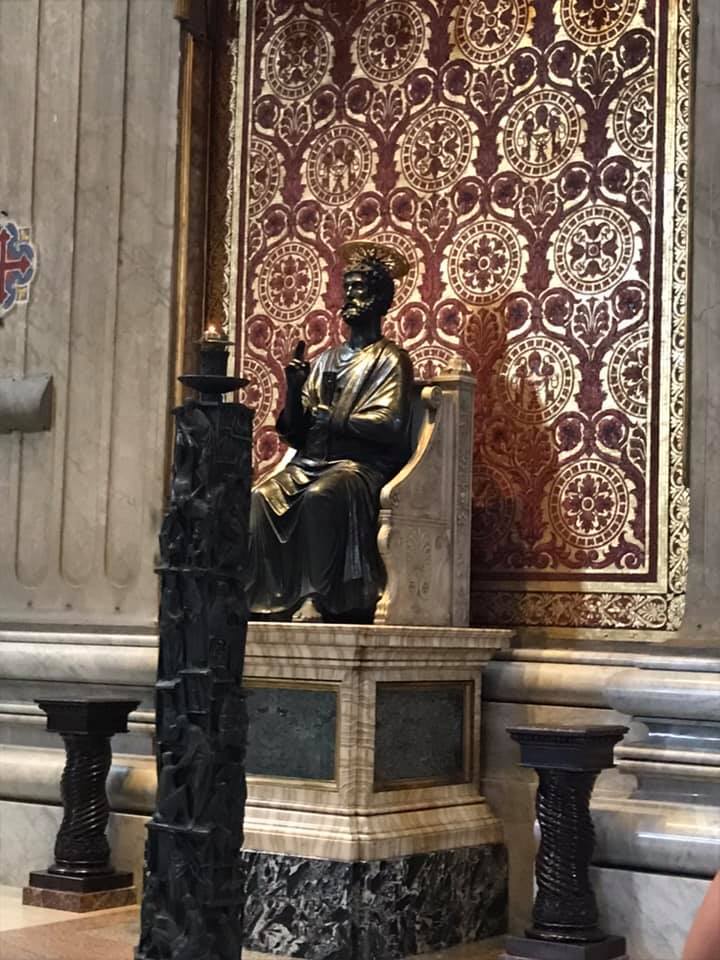
During my visit, I recognized the warm reception by the Vatican to all types of people, regardless of ethnicity, nationality, political affiliation, religious belief, or social class. I felt the worldwide connection of peoples especially when inside St. Peter’s Basilica. This was one of the largest churches in the entire world. It is a source of great spiritual, historical, and artistic importance. This is a destination where the Pope gives mass and isthe largest of the Papal Basilicas. I could see why its beauty, art, history, size, and spiritual significance deeply affects most visitors. 

The Vatican invites everyone and encourages a caring, global community spirit. Its worldwide invitation that invites, but does not seem to pass judgment or exert pressure, reminded me of some of the declarations of Vatican 2, which attempted to bring about greater international religious freedoms, mutual respect, and understandings. Even those of other faiths and those simply curious are welcome to the Vatican. The Vatican symbolizes the Catholic Church, but its ability to influence is far greater. Its messages draw attention and respect around the world.
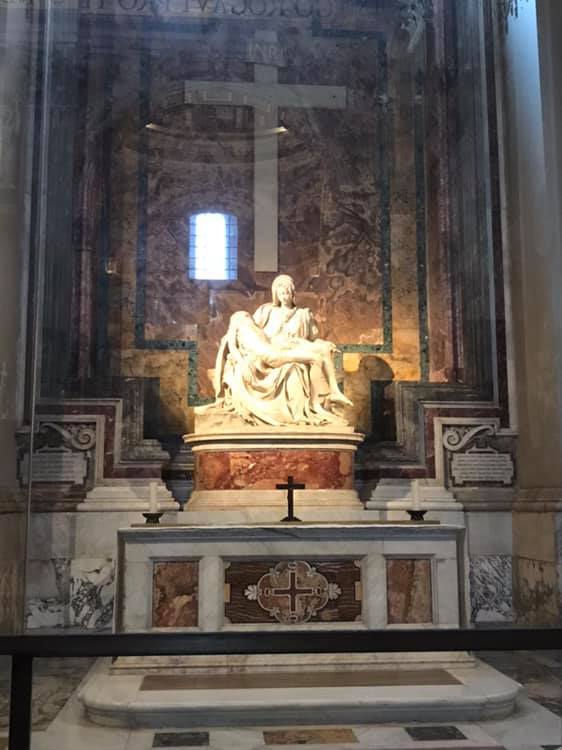
Can You Find the Trinity?

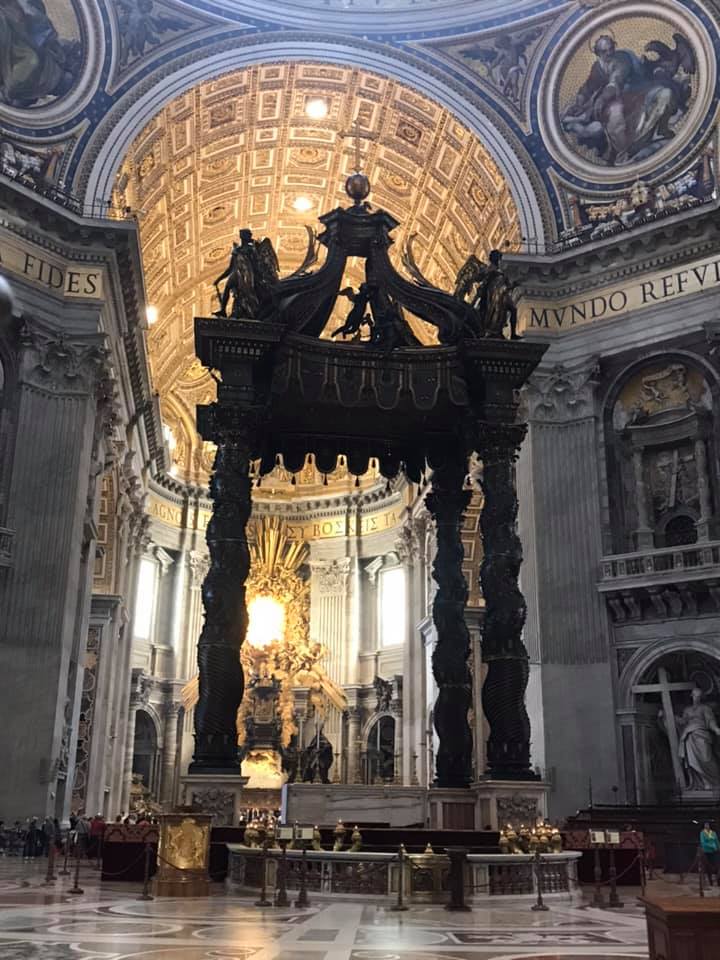
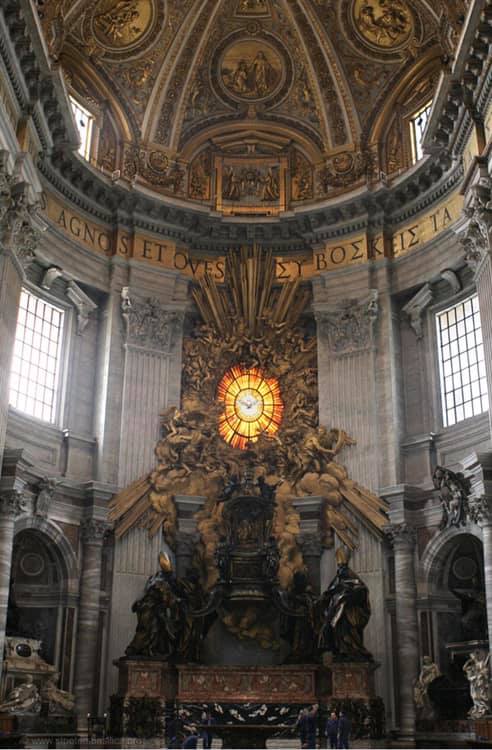
St. Peter’s Basilica at the Vatican clearly reflects the amazing artistic work from some of the greatest masters and is a fantastic source of spiritual inspiration. The pavilion-like bronze structure, which I learned is called the baldacchino created by Italian artist Gian Lorenzo Bernini, was striking to see as we entered. Behind it was a tremendous and dazzling amount of gold, bronze, and filtered sunlight as part of the altar to create the Cathedra Petri, or The Throne of Peter. I was most struck by the oval pane with the dove that was a representation of the Holy Spirit, which was located high above the altar. The light shining through the stain glass around the dove gave a heavenly aura. The gold reaching outwards from the dove, and the surrounding angels, emphasized its significance. The angels also reflected adoration. The Holy Spirit is typically represented as part of the Trinity. Because the Holy Spirit is considered by the Catholic Church to be one of the three persons of the Trinity, it becomes a focal point at St. Peter’s. The dove, or Holy Spirit which guides the Church, was high above everything and draws attention. The entire view of the shining altar, the lighting, and the preeminent location of the dove as the Holy Spirit creates an especially dramatic experience. I felt the power of the Church and noted the significance of grace and faith. The visual representations magnify the emotional intensity of the viewer and bring to mind the importance of God, whose presence was reflected throughout the surroundings. Although the painted stucco ceiling that was part of the dome overhead was hard to fully appreciate because it was far and high above our heads, we could make out depictions of Jesus among the representations. The dome acted as a magnificent, heavenly sky. The overall visual impact of everything around and above the altar suggested a call to understand Jesus and reflect upon the Trinity. The moving view of the altar also increased an appreciation for everything else in the Basilica, such as the sculpture of the Pieta by Michelangelo, which represents the Virgin Mary cradling the dead Jesus after the crucifixion. It is no wonder that St. Peter’s is so highly visited by Catholics as well as non-Catholics. 

Many Paths to God in Rome

My first two days at the Vatican City was a time to spiritually reflect, as well as to appreciate the historical significance of St. Peter’s. James Martin described paths, or 6 ways in which people seek God. They included paths to belief, independence, disbelief, return, exploration, and confusion.  With respect to my time at the Vatican City, the path of return is most analogous to my experience. I was brought up in a Roman Catholic household. I was baptized and sent to CCD until making my first holy communion. I regularly attended Church with the family. As the years passed, however, and I became a teenager, schoolwork became more time consuming. I began to overlook religious obligations, and the Catholic religion became distant to me. Going to the Vatican City was in many ways a returning for me. It was an opportunity to re-connect with my Christian faith. While at Vatican City, I became curious and more pensive about the Christian faith and specifically the Catholic religion. 

            I was fascinated to learn that St. Peter’s Basilica is one of the largest churches in the world, and was the largest until 1989, and dates back to Roman architecture. Its dome and artistic beauty is inspiring to see. One can’t help feel like getting reacquainted with their Catholic faith after visiting such an impressive symbol of the religion. Considering my visit to Vatican City much as a spiritual journey or pilgrimage, I allowed myself time to think about the history it represents, including how the design was undertaken by the greatest designers of the day, like Raphael, and the art is by so many of the great masters, such as Michelangelo’s Pieta. It was interesting to consider that St. Peter’s is believed to have been built over the tomb of St. Peter, one of the 12 apostles. This led to other thoughts, such as how the whitish color seemed to stand for goodness, and its physical size seemed to symbolize the magnitude of what it represented to the Christian world. This all reflected an importance that made me re-consider the value of faith.  While the building of St. Peter’s was an objectionable point by some, such as Martin Luther, it cannot be denied that its magnificence inspires greater spirituality.  

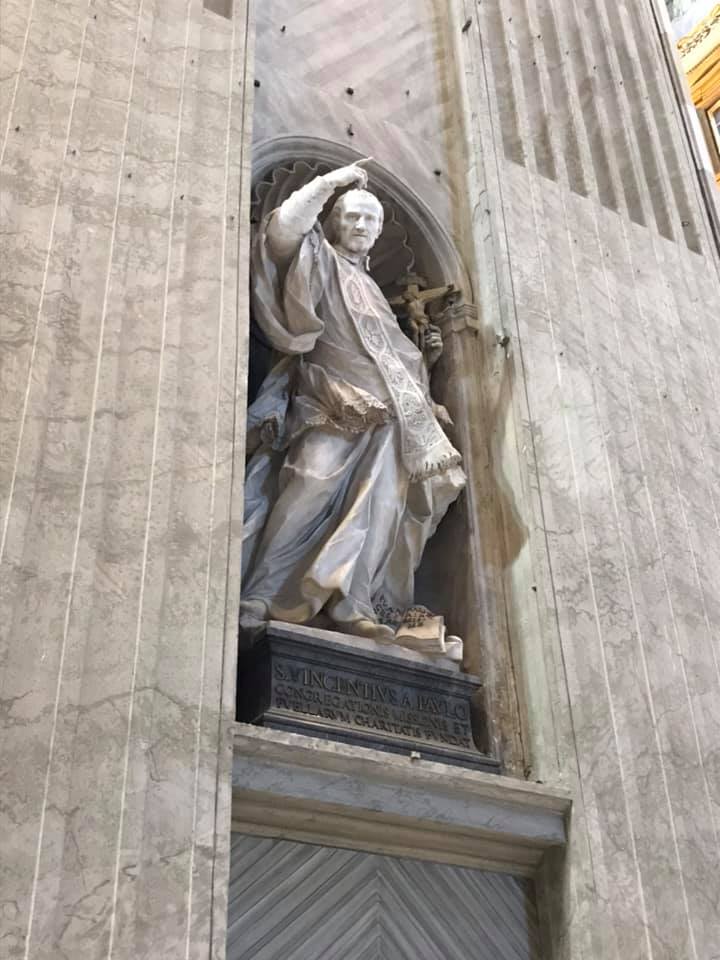
            I had a great experience in Vatican City. It was great to have visited one of the most visited “tourist sites” in the world and to receive a spiritual experience. On the first day, it was interesting to learn new facts about the Vatican, such that the statues all around the Vatican are saints.  It was an amazing sight to see everyone gathered for the papal audience. I could feel the excitement and anticipation of the crowd as we waited to be let into the Vatican. I walked in and immediately saw the pope traveling through the crowd to greet everyone. He talked to the people and kissed children. I will always remember seeing the people’s faces light up when they were able to get a glimpse of the pope. It was also nice to see the joy on his face and to see how he cares about the people. I saw many pictures being taken during the papal audience. Everyone was excited to be there and celebrate the pope. Later, Pope Francis was led to the front of the Vatican to speak to the audience. I believe the pope was speaking Latin and Italian. I stood over to the right near the fountain and looked all around. It was a beautiful sight to see.  The audience cheered for him and waved things in the air multiple times. It was fascinating to feel the importance of this man and reflect upon what he represents to many around the world. This was an unforgettable event. The second day, we visited the Vatican Museum and Saint Peter’s Basilica. The Sistine Chapel  and Saint Peter’s Basilica were breathtaking. It was great to see many different people coming to experience these amazing sites. 

ASL in Rome

InThe Works of Mercy, Pope Francis in “In Solidarity with Those Who Suffer” pointed out that Jesus wants everyone to experience his companionship, help and love. He noted that Jesus identifies with those who suffer and wants man to share that commitment to his fellow man. Pope Francis emphasized that Jesus wants everyone to consider the needs of neighbors, stating, “Jesus keeps knocking on our door … in the faces of those by our side” (11).  This type of concern for others was apparently the focus of the Panini Run in Rome, which was designed to provide food for the hungry. I thought it was an inspiring evening and a reminder that there are people who do not have enough to eat everywhere in the world. The bible parable of the Good Samaritan also came to mind, reflecting how everyone should be considered as brothers and God’s creation. The Panini Run was a wonderfully rewarding learning experience and opportunity to reflect upon those in need.

I was moved by how much spirit and cooperation went into the Panini Run. I was surprised that the Vatican provides feelings of comfort to the homeless in Rome. Students were enthusiastic and energized to help. As we worked, it was great thinking about the people who would benefit from our efforts. The work and overall experience was similar to the charitable work I did at the Midnight Run in New York City a few months ago, organized through the efforts at St. John’s University. At the Midnight Run, SJU students prepared and delivered sandwiches and distributed clothing. 

The Midnight Run and Panini Run were great experiences. My experience at the Panini Run differed from the Midnight Run because of the language barrier. However, I learned that sometimes actions speak louder than words. I walked up to a man leaning against the Vatican. He looked like he was planning to stay the night there. I handed him the food and smiled. It made me very happy that I was able to help him and even put a smile on his face. 

During the Panini Run, I was reminded again of Pope Francis’ passage in “Forms of Nakedness” which noted that the duty to clothe the naked includes the duty to restore their dignity (53).  I was wondering if what we were doing was really enough.  Although supplying food helps, I recognize that there is also a need to reinstate dignity. While helping, I tried to be encouraging and upbeat but reflected on the ways that may better help these people in the long run. 

At the Midnight Run, there were more opportunities to see and connect with the people. I learned that many people enjoy the smiles and interaction with others at these charitable endeavors as much as they enjoy the free meal. In Rome, I was looking forward to a similar experience at the Panini Run. I thought about the social and emotional needs, as well as the physical needs, of those accepting assistance. I was reminded of Pope Francis’ warning that many turn away from the needy because they do not want to be reminded of human misery (88). Despite that serving the needy brings a tinge of sadness to mind, I felt overall gladness to be turning toward those in need and offering help.    

Pilgrims and Tourists

As our class goes to Rome, we are in a sense both tourists and pilgrims. While we may be looking at typical tourist sights, we will also be afforded an opportunity to go to, and reflect upon, the place that has been the center of the Catholic faith.  We will be briefly living in another land, exploring new places, hoping to gain some appreciation of the culture, and acquiring spiritual awareness. As pilgrims, I am excited that we are taking a journey to explore what is important to each of us.

I recall that the bible is full of descriptions of various pilgrimages and, while our stay will be very short, I hope to be able to get to know a bit of the culture and the people.  For me, this means getting out into the community, observing the interactions of people, embracing differences, and reflecting on the significance of where I am. I look forward to being where my Italian ancestors came from and where my religious faith is historical centered. As a tourist, I hope to see the great sights, but as a pilgrim, I have many hopes, including a hope to experience life in Rome and reflect upon how its history and people impacted my life. 

I look forward to meeting other people from around the world. My greatest desire for my time in Rome is to try to feel a connection to the place that many of my ancestors came from. My grandmother still talks about her Italian ancestry.  Additionally, my grandmother is deeply religious, and I look forward to reflecting upon the influence of the Vatican.

Furthermore, it is not enough to say that I saw Rome and all the sights it has to offer. Rome is filled with historical significance, but historical knowledge can be gained from books. Instead, the kind of appreciation I would like to get from this trip can only be realized from personally experiencing the city and relishing its beauty, historical significance, and culture.  

However, I am concerned that time constraints may prevent me from seeing and experiencing as much as I would like. My biggest fear is that, being sponsored by an American university, the trip may not afford enough of a chance to get out there, soak up the atmosphere, and get familiar with the city. I have concerns that the trip may be filled with academic requirements, which while worthwhile or laudable, may take up so much time that there is little room for the personal journey that I would like. I can only hope that there will be enough time. Somehow, I will have to make the time. After all, a trip to Rome is often a once in a lifetime experience.

I greatly look forward to the journey as a pilgrim. I cannot wait to be standing before the Vatican, the basilicas of Rome, the Coliseum, and the other great places of Rome. All of life is a pilgrimage, and I look forward to every minute there.

Image of Christ

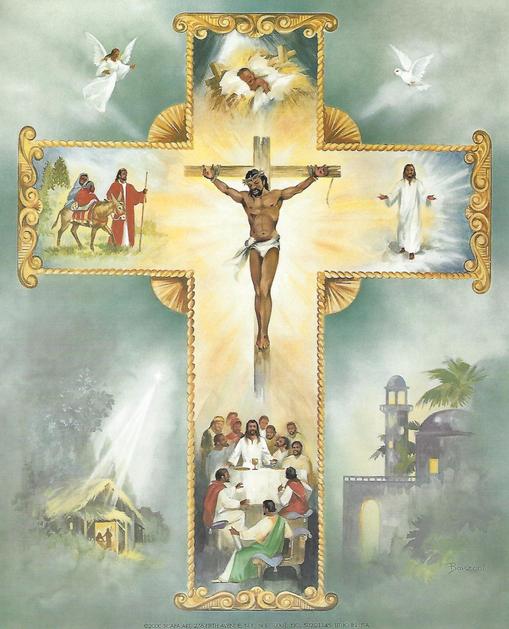
The race and appearance of Jesus has been a topic of discussion. Much artwork has represented Jesus as Caucasian.  Here, Jesus is depicted as black in this work by artist, Vincent Barzoni, to show that the Messiah is not to be considered necessarily Caucasian. In fact, he can be considered African American. 

The religious pieces of Barzoni, and especially this work, have been widely admired. The cross shows various images of the life of Christ. In the center is the crucifixion, while below is the Last Supper, above is Christ’s birth, and the sides show Christ’s journey and sharing the word of God. Portraying Jesus as African American reveals that God can be thought of as black as much as he can be thought of as white. It suggests that Jesus is essentially colorless. It is a reminder that Jesus in Christian theology is the Messiah for all mankind, regardless of race or gender.

Some have argued over the question of Jesus’ race. Arguments range from claims that he is Aryan to a black African. In light of the fact that those at the Last Supper in this work are also black, the piece may be suggesting that Jesus appears to each man in his/her particular image. This would reflect the understanding that Jesus was created in man’s image. Since man has different appearances, the image of Jesus changes for each person. It reflects that concern over the appearance or race of Jesus is unimportant and loses sight of the message that the life of Jesus on earth was to bring salvation to all of mankind.     –Greta Jaye

Mercy and Vincentian ASL Reflection

I participated in the Midnight Run conducted by SJU, which was a food and clothing distribution to help those in need. Most of my previous assumptions about homelessness were largely confirmed by this experience, particularly that those in need include all kinds of people—men and women, young and old, and different ethnicities and backgrounds. 

What challenged me was my concern for providing help to the poor in a way that did not degrade or make the needy feel worse. I was worried about doing or saying something that might make them feel bad about accepting the food or clothing. In this regard, the passage “Forms of Nakedness” within Pope Francis’ The Corporal Works of Mercyseems relevant. It noted that those in need are subject to a type of “nakedness,” and the duty to clothe the naked includes the duty to restore their dignity (53). 

During the charitable work, I also detected that, at times, I felt a little uneasy and unsettled. The following words from The Corporal Works of Mercyaddress this feeling, as follows: “We seek to hide the things that show our human misery” (88). In that writing, Pope Francis urges people not to turn away from those who need help because it is unpleasant to think about the less fortunate. I recall that people often do not help because they do not want to be reminded of things that they do not want to see. I got over initial feelings of uneasiness. However, it was occasionally still difficult to try to contribute to making a positive atmosphere when I was surrounded by a sad side of the world. I pushed negative thoughts aside, and my smiles were then met with smiles from those I was helping. 

            Overall, I found the experience enlightening and rewarding, especially when I watched a woman express great surprise and gratitude when she learned that we brought clothes as well as food. It was heartwarming to see how delighted she was. I was also struck by the degree of organization, effort, and unselfishness that was being provided. There were many volunteers actively involved in this work, and it went on very late into the evening. The kindness toward strangers, even if they may have been different and possibly dejected by some of society, bears similarity to the parable of the Good Samaritan in the Gospel of Luke. In the parable, the Samaritan took care of an injured traveler–a stranger–regardless of whom he may have been. It is a reflection of the Gospel writing that urges man to help his fellow man and not judge. It suggests extending love to everyone, without discrimination, and warns, “Love your neighbor as yourself.” All the volunteers at the Midnight Run seemed happy to help strangers, without judging them. Like the parable, no one was there considering race or religion. Compassion was offered blindly. 

Some of the passages from Pope Francis’ The Corporal Works of Mercyalso relate to this charitable experience and resonated with me. One passage called “The Example of the Simple” emphasized that families should live by the rule that gives to the less fortunate, stating, “There’s always a plate and a bed for the one in need” (49). Another passage, “The Fast That the Lord Wants,” noted that men should not be hypocrites and ashamed of their fellow man (47). Like the Gospel story of the Good Samaritan, they should see all men as their brothers and as God’s creation (48). It suggests extending pure kindness, without consideration for what can be received in return. I felt that the volunteers at the Midnight Run were thoroughly engrossed in that spirit. They were warmly embracing their interactions with those who came for food or clothing. They did not look at them differently. They were not hypocrites. I was proud to be a part of their efforts!

Raphael’s Painting

Greta Jaye

Theology

Raphael – Frame 16

3 April 2019

Raphael’s Painting

Raphael’s painting reflects and glorifies the doctrine of the Trinity, which is one God in three divine persons—the Father, Son, and Holy Spirit. The work portrays a magnificent scene in heaven because it rests upon clouds. The exalted images suggest that Raphael is celebrating the supremacy of Christianity.  

The Son, or Christ, is centered and sitting at what appears like a throne with supporters on each side. God the Father is above him, as if he is presiding over what is below. The Holy Spirit, represented by the white dove, is below Christ, suggesting an uplifting or supporting role. The representation of the Trinity is centered and reflects a visual focal point. The whiteness suggests clouds which reveal that the scene is of the heavens which are elevated above the earth. The lines and brightness that seem to come from and surround Christ suggest that he emits love and the word of God. The Father’s guidance is depicted in a subtle way above Christ. He appears to hold a sphere, or the world, in his hand. This suggests his power as well as his wisdom. Those sitting on Christ’s right and left have halos, which reveal their importance and saintly position. The woman on the left is likely Mary, the mother of Christ. Cherubs at Christ’s feet carry books, which likely contain the word of God from the Gospel. The Father, Son, and Holy Spirit are represented in the painting close together, in a line from top to bottom, almost connected to each other, and emitting the word of God. It shows that there are three separate divine persons who are united.

I selected this painting of the Trinity because I was struck by the references to teachings. The Father is given a scholarly appearance, and the books of God’s words are apparently held by the cherubs for those on earth. This is a reminder that the word of God is the key to man’s redemption. It also suggests that, among the three persons of the Trinity, the source of all knowledge comes from the Father. 

Raphael’s representation of the Trinity has a special impact upon the viewer because of the placement, size, and color of images. With respect to placement, the Father was depicted above all else. This suggests that he guides and directs. Below the Father is the Son, which may reflect that God acts through Christ and sent Christ on his behalf to save mankind. Significantly, Christ appears almost as though he is in a place of honor, surrounded by followers, but God the Father is above him directing and looking down on all that happens. Also, the Holy Spirit is below Christ, which suggests a supportive position. It may mean that Christ is more significant in the eyes of Raphael than the Holy Spirit. Therefore, the location of each may show Raphael’s view of the respective roles and the hierarchy of significance among the three persons of the Trinity. 

With respect to the size of the three persons of the Trinity, Christ is the largest image. He is bleeding, half clothed, and clothed in white, which is all a reminder of the crucifixion. This may reveal Raphael’s view that Christ plays the key role with respect to man’s salvation because of Christ’s sacrifice. The Holy Spirit is the smallest image of the three, which suggests a view that this person of the Trinity is considered by Raphael to be somewhat less important.  

With respect to the use of color, it seems significant that there was a golden light surrounding all three persons of the Trinity. The gold coloring around the Father may suggest that all good things, or in light of the scene’s emphasis on teaching, enlightenment or the word of God comes from the Father. Christ, whose wounds show, is surrounded by brightness and gold coloring, suggesting his victorious resurrection. The Holy Spirit is encircled with an aura of gold, which looks like an energy field. The color gold is typically associated with the concept of success or victory. Therefore, the careful placement of gold in this painting suggests the triumph of Christianity. Additionally, the commonality of the auras and golden light seem to show how all three divine persons—the Father, Son, and Holy Spirit–are part of one God. Also noticeable is the shadow or darker lighting on the Father. This suggests that God the Father works without being known or seen by man. Instead, he sends his son, Christ, to bring the word of God and save sinners. 

Raphael’s painting of the Trinity portrays the preeminence of the God and shows a beautiful work of the Trinity. It emphasizes teachings, the significance of the word of God, and the role of Christ in saving man. The placement, size, color, and brightness used in the painting of the three persons of the Trinity indicate Raphael’s view of their respective spiritual roles, importance, and connection.

What it Means to be Vincentian

Reflecting on the work of Saint Vincent de Paul, it is inspiring that he was not only hard working but also a remarkable leader and force of change. According to Maloney’s article “Fire Within: The Spirituality that Sparked the Works of St. Vincent de Paul,” his impressive contributions include founding the Charities, the Congregation of the Mission, and the Daughters of Charity. He also guided each group he founded. Much of his attention was directed at helping society by providing relief for abandoned infants and those suffering from war, plague, and famine. Being Vincentian reflects a caring dedication of service to others.

St. Vincent was most concerned with what God wants us to do. The film Vincent de Paul: Charity’s Saintemphasized how St. Vincent worked tirelessly toward serving that purpose.  Maloney’s article “Fire Within: The Spirituality that Sparked the Works of St. Vincent de Paul” notes how he was always taking on new causes. His massive relief programs, such as soup for the hungry, for which he organized huge food collections, were among his many projects (Maloney at 7). His admirable work makes me feel like we should all be regularly helping in similar endeavors, such as present-day soup kitchens and other food drives for the poor. Clearly, his spirit of giving to others, and especially the poor, sets an example for us to follow and reveals the Vincentian way. 

Since he founded the community of priests that sponsored St. John’s University, students should feel a sense of gratitude and connection to this Saint and appreciate the spiritual drive he possessed.  We can consider ourselves part of the Vincentian family, which means to be a part of the commitment and ideals of St. Vincent. We should be able to connect with the Vincentian spirit which leads us to service, much as St. Vincent served his community in France. He felt Christ was the “Evangelizer and Servant of the Poor” (Maloney at 8). Therefore, Vincentian-minded individuals relate to Christ’s concern for the poor. Also, it suggests an identification with the spiritual “fire” of St. Vincent. This urges action, as opposed to just prayer or compassion. The film Vincent de Paul: Charity’s Saintnotes that it includes not only doing good things, but doing them well. It is a passion that urges people to consider what God is asking, how to love, how to respond, and then actually responding. It reminds us that God has a plan, which followers must discern, and it requires a need to listen and act (Film: Vincent de Paul: Charity’s Saint).

If we have Vincentian spirit, we should also appreciate the importance he placed on speaking the truth, exercising humility, and zealously loving others. St. Vincent spoke and wrote about these values (Maloney at 8-10).  The film also described the importance he placed on simplicity or honesty and gentleness. He was compassionate and respectful. To be Vincentian means to demonstrate these values in daily lives. St. John’s University offers students opportunities to get involved with the community for the sake of the community and, therefore, explore this spirituality. Charitable work seems to be a particularly good chance to reflect Vincentian values.

Adopting the Vincentian mindset recognizes the benefits of working collaboratively, especially as part of organized institutions. The film Vincent de Paul: Charity’s Saintpoints out how Vincent de Paul institutionalized charity. He did not just go out into the streets to help the poor. He realized the need for organized efforts and created the organizations. To build upon his legacy, Vincentians embrace working together to provide service to others, much as St. Vincent, with the help of Louise de Marillac, created the Ladies of Charity and Daughters of Charity (Film: Vincent de Paul: Charity’s Saint). 

            The film describes Vincent de Paul as an “apostle of charity.”  The Vincentian tries to follow the same path, regardless of the perceived worthiness of the individual in need.  For example, the film noted how St. Vincent felt compassion and the need to help the prisoners serving their sentence on galley ships. He was horrified by their treatment and felt that even these people deserved his help. Another example is how he felt the need to help the abandoned infants. At that time, abandoned infants were considered the product of sin and wrongful behavior and not worthy of help. In contrast, St. Vincent felt all were children of God and deserving. This beneficence is part of the Vincentian spirit. Charity is not supposed to pass judgment. A Vincentian spirit recognizes that all people are loved by God and should not be neglected.

Vincentians reflect upon the life and ideals of St. Vincent and model his efforts. It is noteworthy that he became a respected spiritual counselor to key figures, including other spiritual leaders, and royalty in 17thCentury France but never lost sight of the importance of helping the less fortunate, especially the poor and abandoned in society (Maloney at 7). Therefore, to be Vincentian requires remembering the needy. 

St. Vincent’s mission to reform the Church was an amazing accomplishment, particularly when it is remembered that France at the time was always involved in war. The film noted he was a “symbol of Catholic reformation,” and, as praised by the priest at his funeral, he effectively “changed the face of the Church” (Film: Vincent de Paul: Charity’s Saint). His success was due to his talent as an effective organizer and executive. He reformed the clergy and parish. To be Vincentian in the formal sense is to be a member of the Congregation of the Mission, a Roman Catholic society of priests and brothers founded by St. Vincent to preach missions to the poor and train priests. St. Vincent’s big plans made his mission spread beyond the local community to all of France. To be Vincentian is to be devoted to missions and missionaries. Attempting to model efforts after St. Vincent, they try to bring long-lasting worldwide changes.

            The film also noted that St. Vincent, when young, was focused on just finding a job, much as students attending St. John’s University. His later spiritual conversion, as described in the film, redirected his focus to service in the way God wanted (Film: Vincent de Paul: Charity’s Saint). This change suggests that the Vincentian way is to be open to a spiritual growth over time. The film also noted that, while he was influenced by St. Ignatius of Loyola and other spiritual leaders, he became his own leader of the poor. This further suggests that the Vincentian spirit includes a sense of independence and an openness to our own paths and spiritual growth.

            To be Vincentian is to follow St. Vincent’s dedication of advocacy for those most abandoned. He was devoted to helping the poor, the abandoned children, the prisoners on the galleys, and those suffering in hospitals because he was committed to being a follower of Jesus. This indicates that to be Vincentian, one should actively work to help the poor, not only to benefit them, but to change lives (Film: Vincent de Paul: Charity’s Saint).  

            Significantly, Vincentians focus upon the following question: “What must be done?”  This question was the directional force behind much of St. Vincent’s accomplishments (Film: Vincent de Paul: Charity’s Saint).  By reflection upon this question, Vincentians are led to consider what they should do to help the poor and suffering. They strive to follow Jesus as the Evangelizer. They can look to St. Vincent, his work and ideals, as a spiritual model.